The Material
Clay is one of the oldest materials on earth — dug from the ground, shaped by hand, transformed by fire. I work with stoneware, porcelain, and a custom clay body I make myself. Venus sculptures require an earthy body that holds texture and carries memory to its surface. Clay resists hurry. It cracks if you push too fast, warps if you don’t listen. Working with it demands a particular kind of attention — and that, more than anything, is what keeps me here.
“Clay rewards patience and resists hurry. It is the right material for work that is meant to last.”
The Making
My sculptures and decorative work are mostly handbuilt. Handbuilding produces a quality of surface and form that cannot be replicated on the wheel: each piece holds the trace of how it was made. A coil left visible. A thumb-pressed wall. An edge that curves just slightly off true.
“These are not imperfections — they are the signature of the hand.”
For functional pieces — candleholders, bowls, platters — I begin on the wheel, then alter the thrown form by hand while it is still soft. The wheel provides structure and symmetry; the hand introduces tension, gesture, and character. The result is functional ware that is alive in a way that purely mechanical production cannot be.
Below: throwing a tall bulbous candleholder on the wheel in three stages.


The Firing
Finished pieces dry slowly — sometimes for days — before going into the kiln for their first firing. This bisque firing drives out the last moisture and converts raw clay into something permanent and porous, ready to accept glaze. After glazing, each piece returns to the kiln for the final high-temperature firing, where the real transformation happens. Glaze melts, flows, blisters, and settles. Colours deepen or shift entirely. Surfaces develop a depth that was not there before.
“The kiln is where I lose control — and where the work often surprises me.”


The Glaze
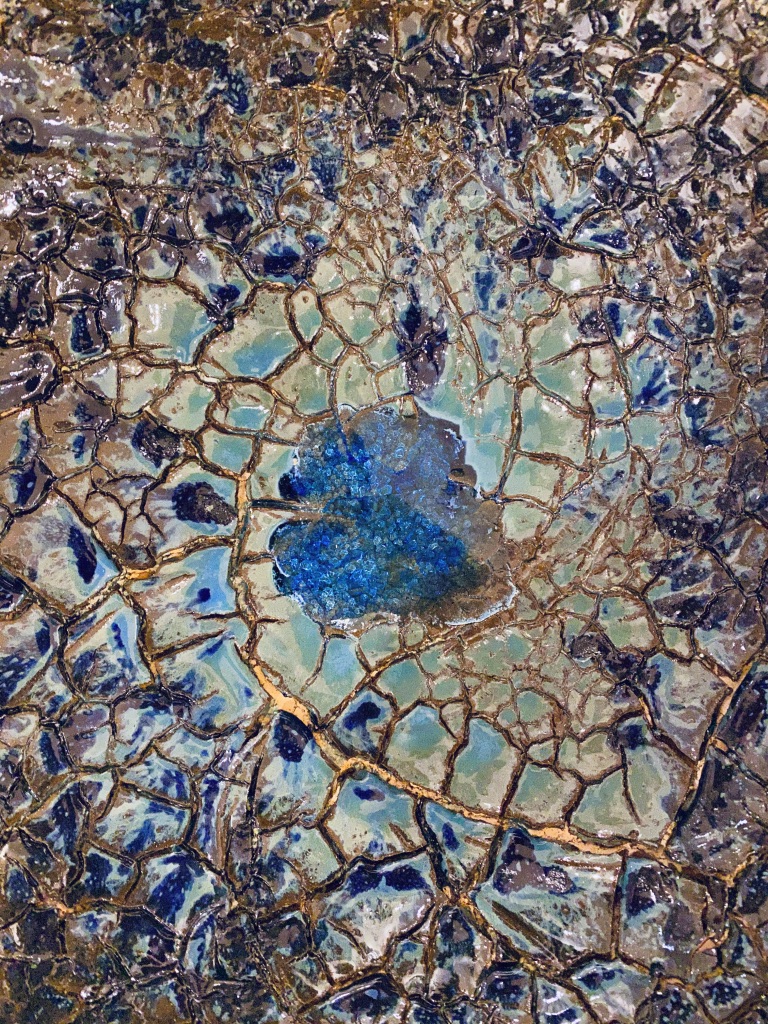
Surface is never an afterthought. For sculptural and decorative work, I favour earthy, mineral finishes — rough textures, muted tones, surfaces that feel closer to stone or soil than to ceramic. Sometimes a piece is left almost entirely unglazed, its raw clay body doing the work. The image at the top of this page is a detail from one such piece: a crackled glaze pulling apart to reveal the layer beneath, gold seeping into the fractures like something geological.
Functional pieces follow a different logic. Any surface that meets food — the inside of a bowl, the rim of a mug — is fully glazed with food-safe, durable finishes. Beauty and utility held together in the same object.
The Studio
I work in Toronto — concrete, glass, noise — but I grew up surrounded by fields, rocks, lakes, and trees. That gap between the natural and the fabricated has never closed for me; it runs through everything I make. The studio is where the two worlds meet. Clay arrives raw and full of possibility. It leaves as something fixed, finished, held. Between those two states is where the work lives — and where I am most at home.
“Between those two states is where the work lives — and where I am most at home.”